
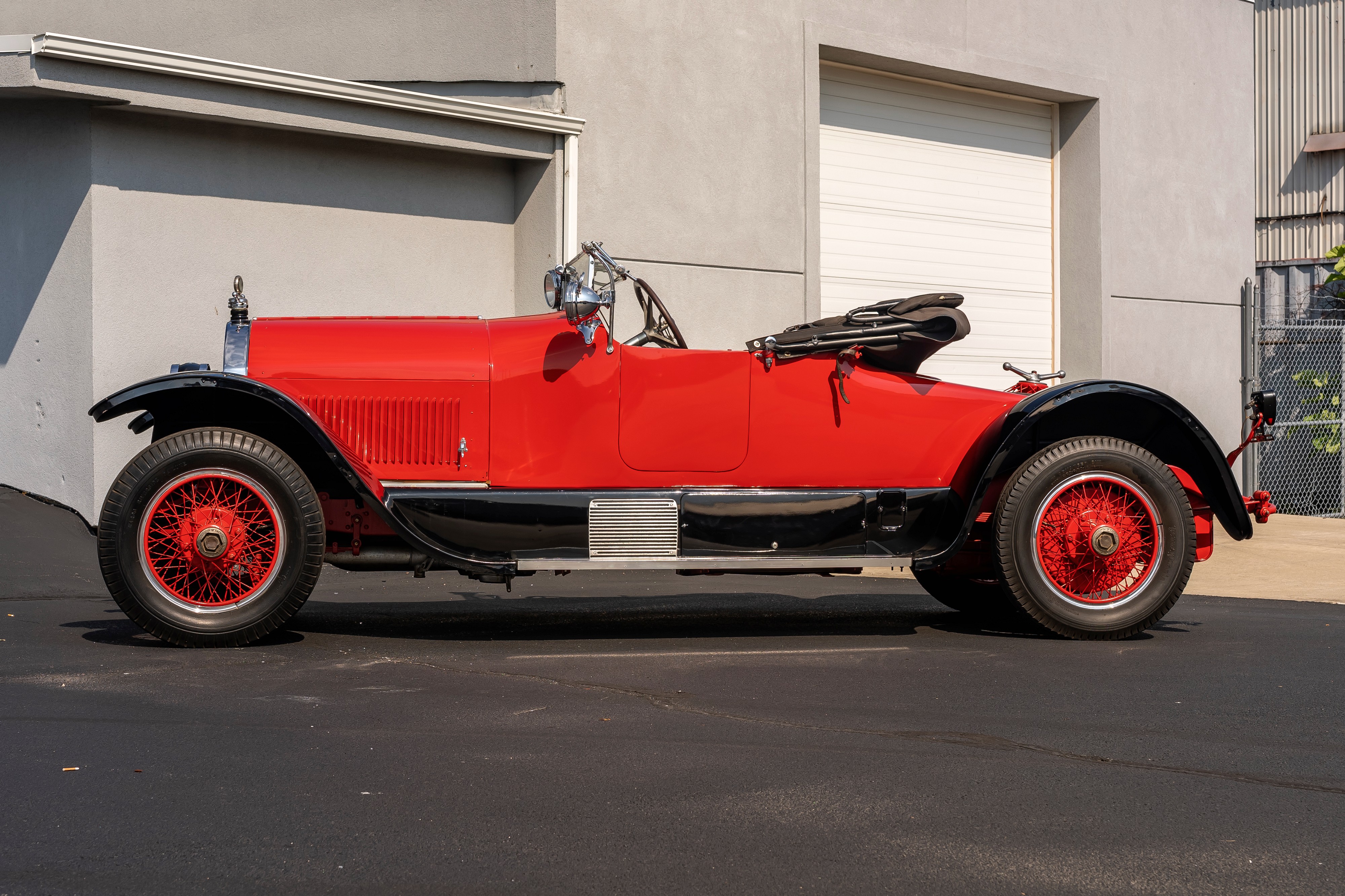


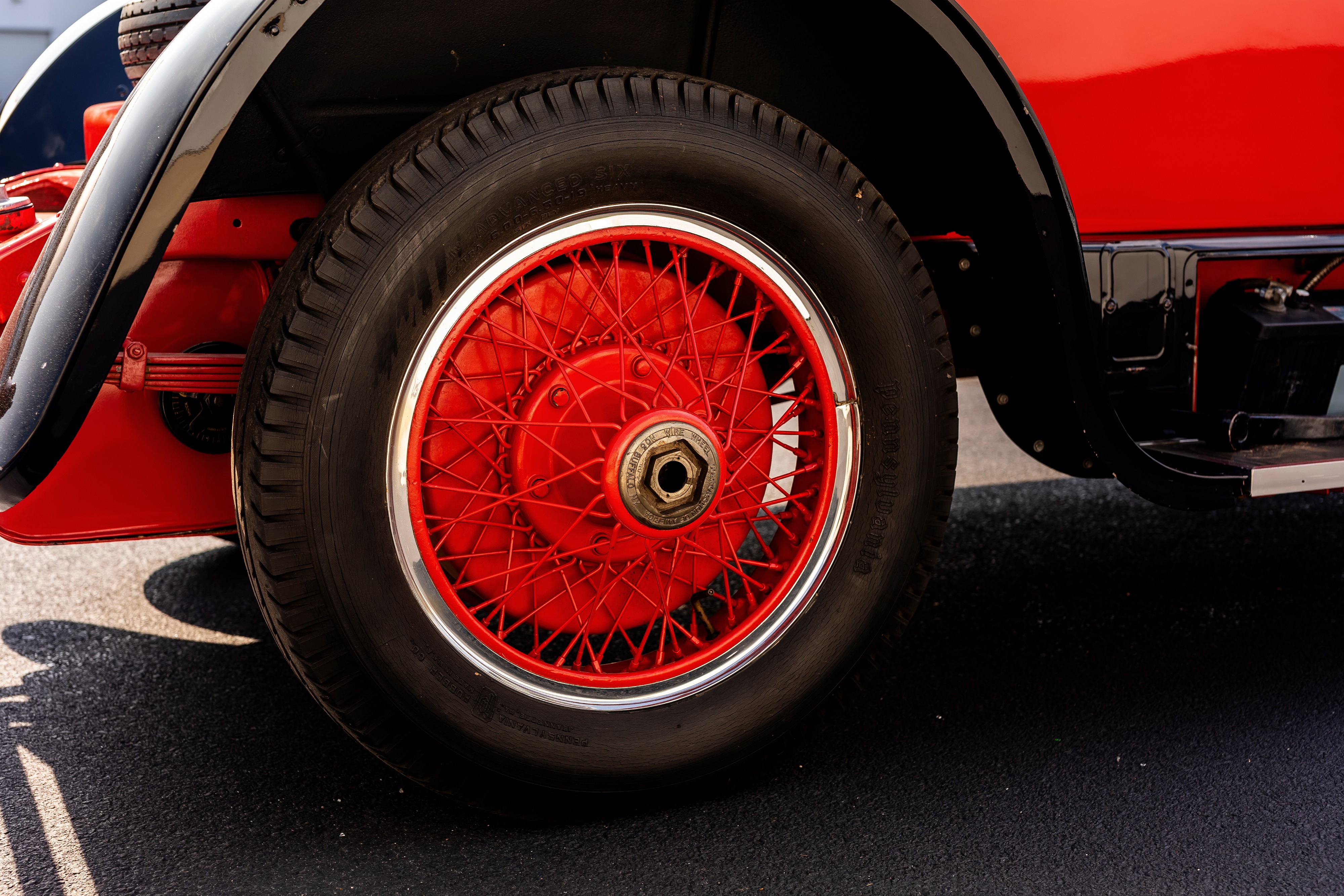

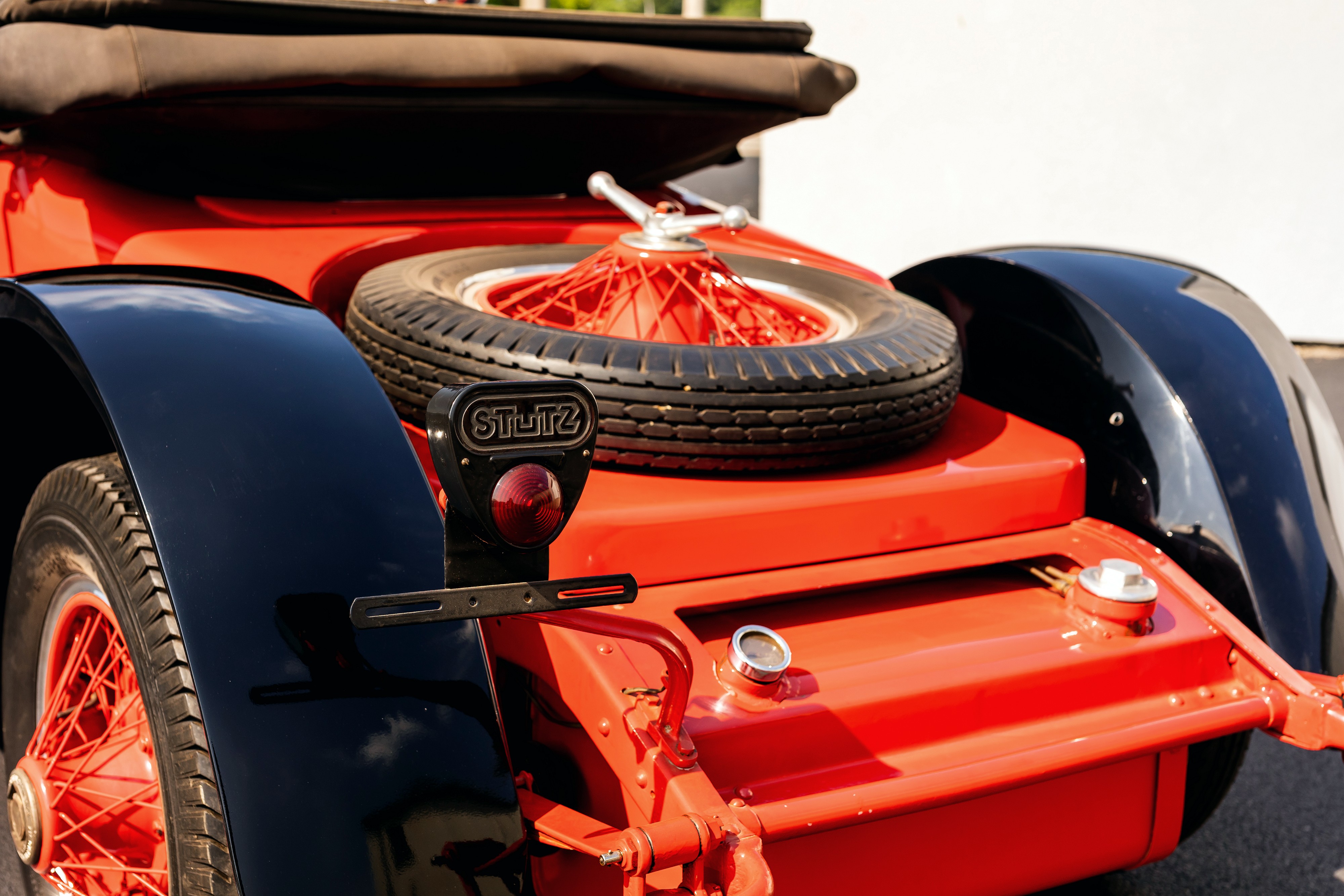


1922 Stutz Series K Roadster
Inventory Number: 3128
$125,000
- ENGINE: T-Head 4-Cylinder 16-Valve 4.7 Liter Configuration
- HP: 80
- VIN#: D13642H
- INTERIOR COLOR: Black
- EXTERIOR COLOR: Red
- BHP: 92 at 3,000 RPM
- SPEEDOMETER: Stewart-Warner, Chicago, IL
The 1922 Stutz Series K Roadster was a high-performance automobile known for its powerful engine and sporty design. It was a two-passenger roadster, often referred to as the “Speedway Four Roadster,” that shared many characteristics with the famed Bearcat series but was distinguishable by a 10-inch longer, more comfortable chassis. It was popular, featuring a T-head, four-cylinder, 4.7-liter engine with 16 valves and 80 HP. It operated with a single overhead camshaft and dual ignition, producing 92 BHP at 3,000 RPM. With a low-to-the-ground profile and dramatic, “all engine” appearance, it was designed for speed and racing.
Until entering the Dick Shappy Collection, the model seen here had spent its entire existence in Southern California, which explains the high-quality preservation it displays today.
The Ideal Motor Car Company was founded in 1911 in Indianapolis, Indiana, by Harry Stutz and Henry Campbell to build Stutz automobiles. They entered a Stutz they created under the name “Stutz Auto Parts Co.” into the Indianapolis 500, placing 11th and earning the car the moniker “the car that made good in a day” after they built it in less than five weeks. They began producing more of the race car, called the Stutz Bearcat, and eventually became the Stutz Motor Car Company in 1913, which would go on to produce high-end sports and luxury cars.
In 1919, Stutz left to form other companies, leaving Allan Aloysius Ryan in control of Stutz Motor, who got the company into trouble for stock manipulation a year later and bankrupted it by 1922. The new owners brought in Frederick Ewan Moskowics in 1923, under whose guidance they pivoted to producing safety cars. In 1933, they began focusing on delivery vehicles, eventually ceasing production of automobiles after producing 35,000. In 1935, Stutz was again charged with stock manipulation, filed for bankruptcy in 1937, and was liquidated in 1939.
Stutz was revived in 1968 by New York banker James O’Donnell into Stutz Motor Car of America to produce neoclassic automobiles and saw reasonable success, though production was limited. Sales began to wane in 1985, and production ceased in 1995, with only 617 vehicles made, though the company still exists.
Throughout its checkered past, Stutz accomplished many things. It was credited with developing the underslung chassis and, at one point, was advertised as the “World’s Most Expensive Car.” Many celebrities purchased Stutz automobiles, including Elvis Presley, Frank Sinatra, Dean Martin, Evel Knievel, Barry White, Sammy Davis, Jr., and Lucille Ball. In total, the company produced 39,000 automobiles of various models.
FROM THE SHAPPY ARCHIVES:
Stutz Advertisement: “Stutz Indianapolis, Indiana, US. World’s Champion.
World’s Records for Consistency: 4 Consecutive 1st and 2nds. Records Established 1915.
World’s Long Distance Records: 300 and 350 Miles. Records Established 1915.
Consistency Records Re-Established - Vanderbilt and Grand Prize Races held November 16 and 18, 1916. Vanderbilt - Distance 294 Miles Average 83.74. This performance by Private Owner. Grand Prize - Distance 403 Miles Average 83.74. This Performance by Private Owner. None of the above records equaled.
The World’s Champions: The Stutz is a strong, sturdy car. It has a reputation as a fighter. It has never known a knockout, and seldom felt the sting of defeat. The race course has been its cradle. Racing has accelerated the development of the automobile. Among American made and European cars the name Stutz undoubtedly stands pre-eminent on the race course. Our engineers have the benefits of its first-hand experience and from which the 16-valve motor was designed, developed and produced.”